Lath.
Where every plaster job starts.
The substrate is where almost every plaster failure begins — improperly lapped paper, missed weep screed, fasteners on wrong centers. We're sticklers about lath because a perfect finish coat can't fix a sloppy backup.
What we install
- Metal lath — 3.4 lb galvanized self-furring, attached on 7-inch vertical centers and 16-inch horizontal centers to wood-frame, steel-stud, or masonry substrates.
- Weather barrier — two layers of Grade-D building paper, properly lapped and integrated with all window, door, and penetration flashings.
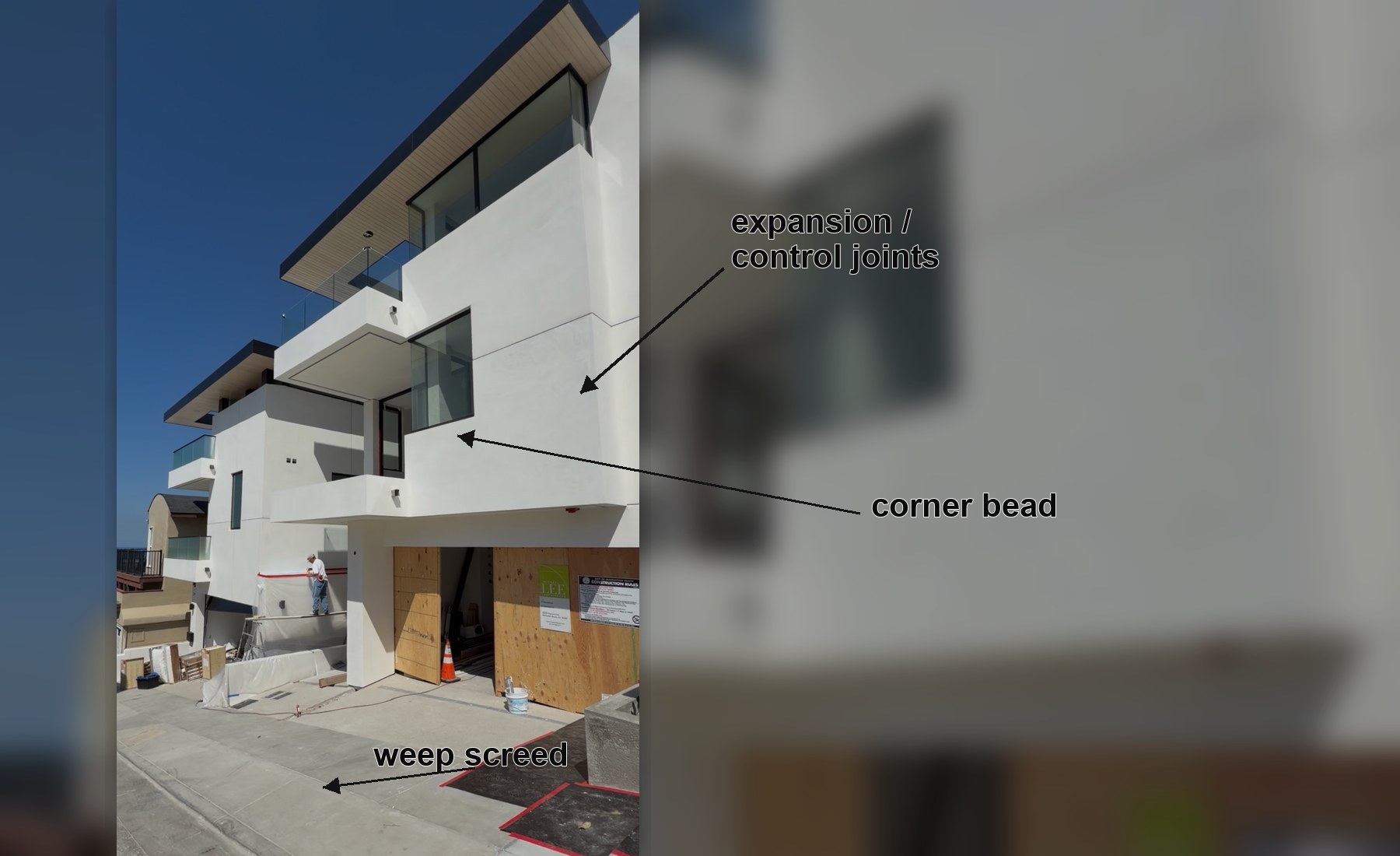
- Accessories — galvanized weep screed, casing beads, corner aid, expanded-wing corner bead, and control / expansion joints sized to the assembly.
- Penetration flashing — sleeves, sleeves, and more sleeves. Every pipe, vent, and fixture gets flashed and sealed before lath goes up, not after.
Why the substrate matters
Plaster fails at the substrate. Not at the finish coat. By the time a hairline crack shows up on a finished wall, the cause is usually traced back to one of five lath-stage mistakes — paper laps in the wrong direction, weep screed buried in dirt, fasteners over-driven, expansion joints missed, or a corner bead that's not square.
That's why we treat the lath inspection as the most important walkthrough of the job. If your superintendent doesn't have time to walk it with us, we'll do it twice ourselves.
Substrates we work on
- Wood-frame construction (Type V residential)
- Light-gauge steel-stud framing (Type V and Type II commercial)
- CMU and poured-concrete walls
- Existing plaster — overlays, patches, and tie-ins
- Curved walls, soffits, returns, and reveals
Code compliance, written down
Every lath assembly we install meets or exceeds CBC and ASTM C-1063 requirements. Submittals — product data sheets, fastener schedules, paper lap diagrams — delivered with the bid. If your plans-check or inspector has a specific note, send it over and we'll match it word for word.
The spec,
for the bid sheet.
| Lath | 3.4 lb galvanized self-furring metal lath, K-Lath or equal |
|---|---|
| Paper | Two layers Grade-D 60-minute building paper, ASTM D226 |
| Fasteners | Galvanized roofing nails or self-tapping screws, 7-in. O.C. vertical, 16-in. O.C. horizontal |
| Weep Screed | 26-ga. galvanized, set 4 in. above earth or 2 in. above paved surfaces (CBC §2512.1.2) |
| Corner Bead | Expanded-wing galvanized, full-height continuous |
| Expansion Joints | Every 144 sq ft or 18 LF max, per ASTM C-1063 |
| Penetration Flashing | Self-adhering flashing tape, installed before lath, lapped over WRB |
| Inspection | Pre-coat walkthrough with superintendent + Richartz foreman |
"
We don't sub our lath out anymore. Richartz catches things at the substrate that our framers and ours subs miss — saves us punch and re-work every time.
— Custom Home Builder · Manhattan Beach
Recent Lath Work